Mastering Forces with Intelligent Design
The KORSCH Compression Roller Station – A Key Design Principle
Tablet presses must withstand enormous forces during the tableting process – depending on the application, forces of more than 100 kN may occur. Managing these loads safely without compromising precision, machine longevity, or ease of operation has always been one of the fundamental engineering challenges in tablet press design.
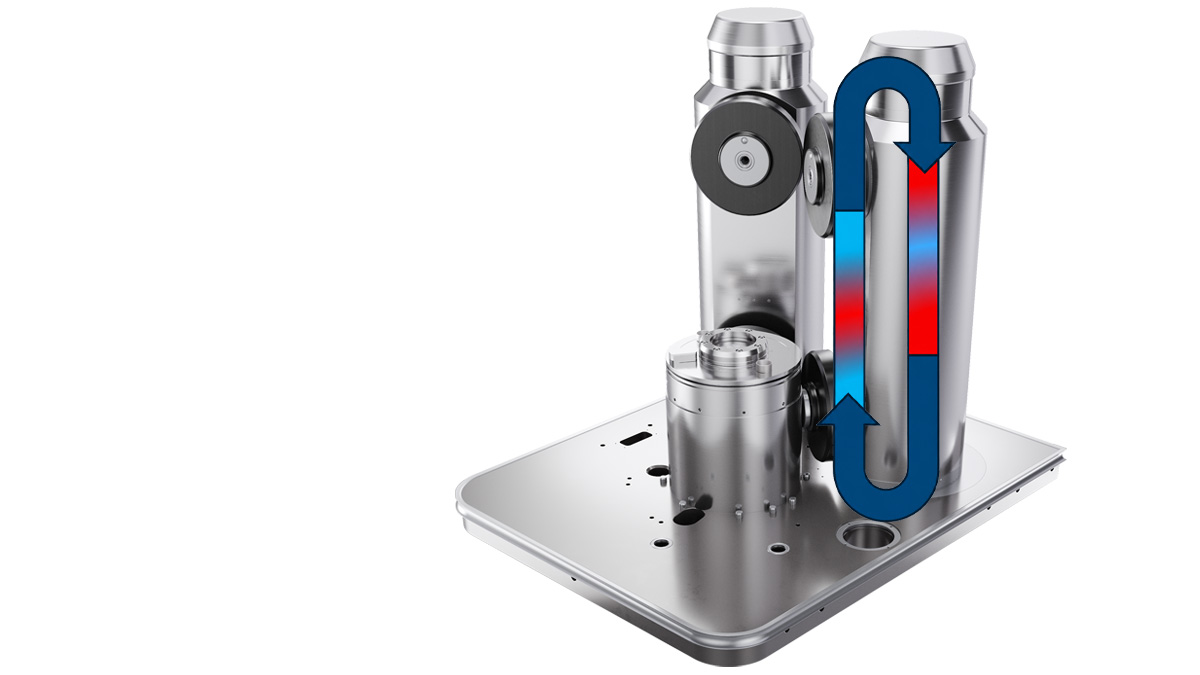
Until the 1990s, the force transmission path in KORSCH rotary tablet presses followed a conventional machine design: The upper and lower compression rollers were mounted separately to the machine head piece and machine frame. During compression, high compression forces naturally caused the rollers to move apart. The resulting forces were transferred through the roller supports into the machine frame, causing structural components such as the head piece and the machine frame to vibrate. Since these vibrations occurred within the audible frequency range, they led to significant noise emissions.
To overcome these inherent design limitations, KORSCH developed a patented compression roller station. The key difference compared to the conventional design is that the upper and lower compression rollers are no longer mounted separately but integrated within a common guide column and can be adjusted relative to one another. This allows the compression forces to be absorbed directly within the compression roller station rather than being transmitted through the complete machine frame. The result is significantly reduced vibration, lower noise emissions, and optimized force transmission.
The patented compression roller station is available in two configurations. One version features a fully enclosed cylindrical guide column with a smooth surface that fully meets the stringent hygienic requirements of pharmaceutical manufacturing. The second version utilizes an open frame design enclosed by cover plates. This design provides improved access to internal components, considerably simplifying maintenance and service operations.
Both configurations offer another important advantage: The upper and lower compression roller assemblies can be adjusted either independently or synchronously. Synchronous adjustment is used to set the position of the compression zone. Relative adjustment of the upper and lower rollers, allows for precise adjustment of the edge thickness, and, consequently, the tablet thickness. This flexibility both simplifies machine setup and process control throughout production.
To this day, the movable compression roller column has formed the technological foundation of another hallmark KORSCH innovation: the Multifunction Platform (MFP). It provides the basis for maximum flexibility in adjusting press parameters and represents a key feature of modern high-performance tablet presses.