The Role of Continuous Manufacturing in Large-Batch Production
KORSCH: Is Continuous Manufacturing (CM) an answer to the requirements of large-batch production?
Robin Meier: First, let us clear up a common misunderstanding: continuous manufacturing does not mean uninterrupted production around the clock. In fact, it means continuous material inflow into or outflow from the production process. And yes: CM offers plenty of potential for high-volume production. However, the focus is more on quality enhancement than on throughput quantities.
KORSCH: What benefits does CM offer?
Robin Meier: Keyword quality. CM massively reduces the risk of segregation in the direct compression process, for example, because the material is constantly in motion within the system. This simplifies feeding and mixing, especially of drugs and excipients with poor flow properties. For example, errors resulting from minimal material deviations can also be detected much faster, and defective products can be rejected immediately. At the same time, upstream process-stage parameters can be corrected to ensure a return to the design space. And last but not least, it can also save product development time and materials.
KORSCH: When does it make sense to switch from batch production to CM?
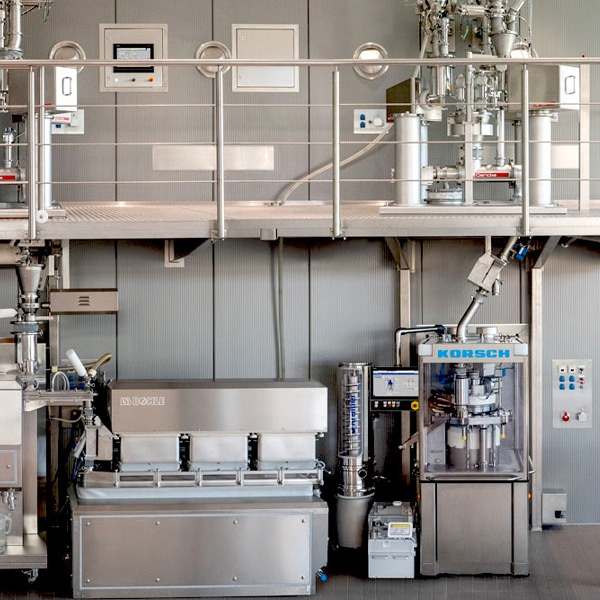
Robin Meier: That is always a strategic issue. In the case of existing, large-volume batch production involving small margins, decision-makers need to check whether reinvestment makes commercial sense. CM should definitely be considered in the event of quality problems or if investment in a new plant is planned – perhaps initially only for certain sections. Ultimately, it is a huge puzzle made up of many pieces. This is where KORSCH and L.B. Bohle can leverage their process engineering strengths and develop special solutions.
KORSCH: Is CM cheaper than batch production?
Robin Meier: CM offers high potential savings as far as operating and energy costs are concerned. For example, CM requires only 10 percent of the air volume for the wet granulation drying process that batch production does. Here, too, various scenarios can be reviewed. Ultimately, you must look at each case individually.
KORSCH: Thank you very much for the interesting interview!